Benchmarks Blog
Applied AI
Methodology, benchmarks, and analysis behind Lilt's multilingual AI data services.
LILTBench Hackathon Is a Wrap: 85 Attempts to Break a Frontier Model Across 31 Languages
LILTBench's six-day hackathon evaluated 83 community-built coding tasks across 31 languages against Claude Opus 4.6, measuring the performance gap between native-language and English prompts. Difficulty was bimodal, Chinese tasks were hardest (22% pass rate), and results reveal where frontier models still fail outside English.
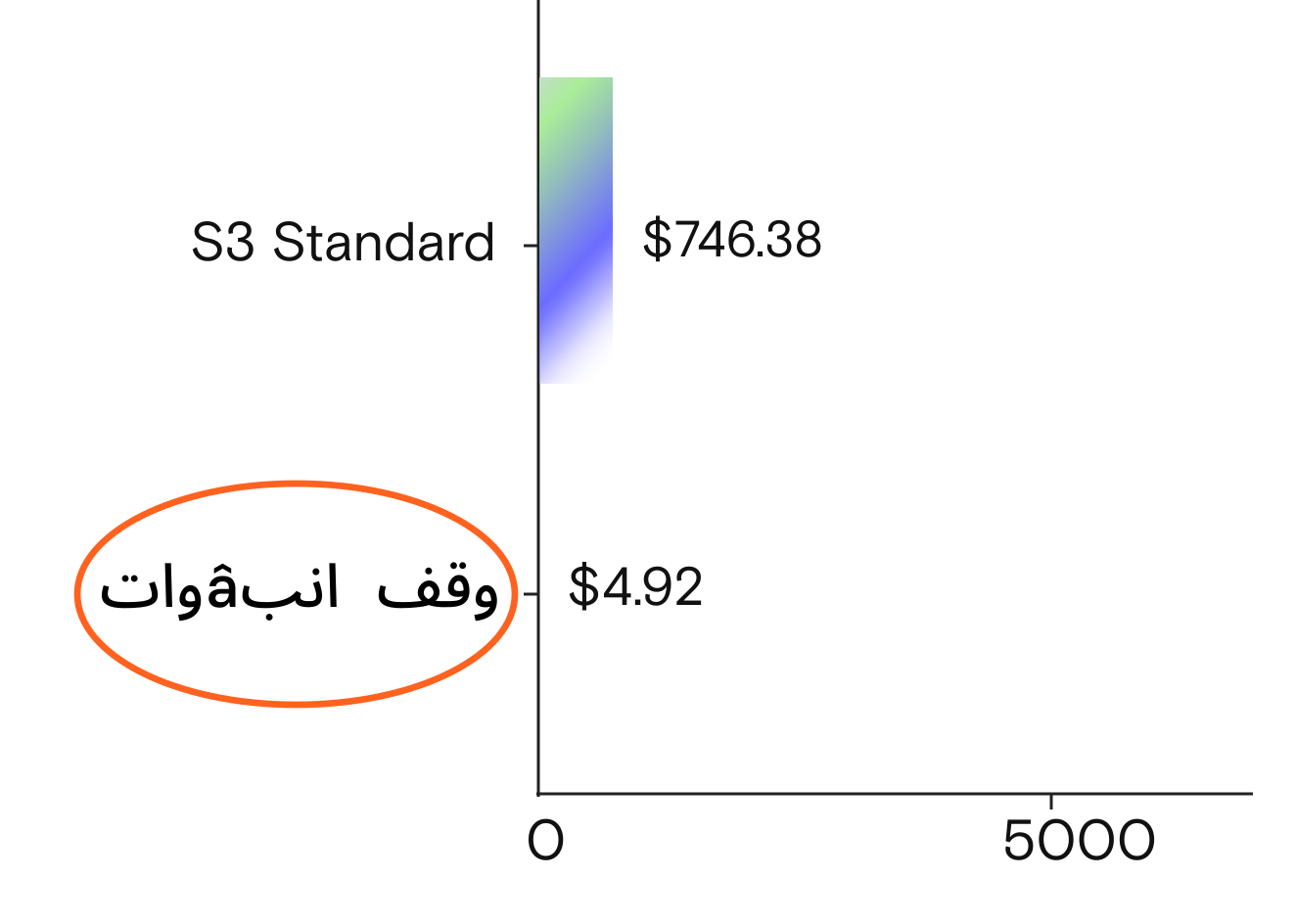
The Hidden AI Coding Gap: Why Non-English Development Lags Behind
AI coding tools score high on English benchmarks but fail non-English developers. LILT's research reveals systematic gaps in Arabic character shaping, Korean grammar, and locale handling, showing leading models like GPT-5.5, Gemini 3.1 Pro, and Claude Opus 4.7 drop sharply when tasks switch from English to native languages.

The Multilingual Blind Spot: Why Enterprise AI Requires Native Language Benchmarking
English-first AI benchmarks miss critical failures in global deployments. This article explains why enterprises need multilingual benchmarking, how cross-lingual drift and cultural edge cases create silent failures, and how LILT evaluates AI models natively across 200+ languages with localized golden datasets.

Multilingual Voice AI in Customer Service: Beyond Translation | LILT
Most enterprise voice AI fails when customers speak with accents, dialects, or emotion. This guide explores why multilingual customer service demands more than translation: accurate ASR across accents, culturally calibrated sentiment, PII-safe training data, and compliance-grade transcription that truly understands every caller.

Beyond Translation: Announcing GAIA-v2-LILT the Multilingual Agent Benchmark That Actually Measures What It Claims To
GAIA-v2-LILT is a re-audited multilingual extension of the GAIA benchmark covering Arabic, German, Hindi, Korean, and Portuguese. It reveals that roughly 20 percentage points of measured multilingual performance gaps stem from benchmark translation artifacts rather than genuine AI model capability limits.

Africa is Redefining AI Usability: A Call for Multilingual, Multimodal AI.
Africa is pioneering voice-native, multilingual AI through WhatsApp-based tools for agriculture, fintech, and community services. Deployments in Malawi, Senegal, and South Africa prove that designing for real-world constraints like low literacy, code-switching, and spotty connectivity produces more robust, globally relevant AI systems.

AI’s Language Gap: Why True Access Requires More Than Translation
AI still excludes billions by favoring dominant languages, and translation alone can't close the gap. True access means treating multilinguality as core infrastructure, not an afterthought, via localization and native voice processing.
The Origin of Multilingual Performance Gap: A Deep Dive into Multi-Turn Conversational Agents
The research identifies why LLMs struggle in non-English languages using the MultiChallenge benchmark. While data artifacts and language nuances play a role, model limitations like tokenizer inefficiencies and English-centric reasoning account for over 70-80% of failures. The post advocates for targeted post-training as a cost-effective solution to bridge the gap.

Beyond "Top-K" RAG: The Role of SME-Verified Data in High-Fidelity AI Model Training
To make LLMs useful for specialized sectors like law or medicine, organizations are turning to Retrieval-Augmented Generation (RAG). However, relying solely on "Top-K" retrieval – the process of pulling the most mathematically similar chunks of data – isn't always sufficient for high-fidelity AI model training.

Beyond Translation: What High-Quality Multilingual Agent Benchmarks Actually Require
LLMs like ChatGPT and Gemini are now agents that solve complex, multi-step tasks, calling tools at the right moment. Yet there's a major blind spot in how we measure their success in non-English contexts—and what strong multilingual benchmarks require.

The Multilingual RLHF Gap: Why Global LLMs Fail Without Cultural Alignment
Reinforcement Learning from Human Feedback is the industry standard for the final step in LLM training, designed to align a model’s raw output with human values.